The Earth and Climate Action Ministry (ECAM) has started to talk with groups around church to hear ideas, concerns and hopes about taking better care of the earth.. We are gathering East Shore’s passions and perspectives and we need YOURS!
We would appreciate the opportunity to have a short conversation about:
What are some positive outcomes you dream about for the Earth and climate?
What relevant issues or activities do you think are important for ESUC to address?
Our goal is to gather as many perspectives as we can, pull them together, and celebrate our joint passions and ideas at a church service and special event near Earth Day (April 21).
Either Zoom or in-person meetings would be possible. If your team meets regularly, perhaps we could have a short time on an agenda for this activity. We are also open to individual conversations and written input.
Hope to join you sometime soon for this important church-wide conversation! Please contact Kristi Weir or another member of the ECAM Team below who may reach out to you to get started.
ECAM Team: John Chmaj, Karin Elofson, Ann Fletcher, Ron Lovell, Marilyn Mayers, Jill McGrath, Mark Norelius, Kari Ann Hailey, Kristi Weir
Connect with 350 WA
Here is an easy way to support bold, sound, and just climate legislation in the Washington state during this year’s short session (Jan 8-Mar 7).
Join the 350 WA Civic Action Team (CAT) which will send you two easy-access emails per week which are tailored with options for how much time you have (from 5 to 20 minutes). The bi-weekly email lists the climate bills with top priority for the week. After the brief explanation of the bill, click on a link to register your Pro or Con position on a bill. You may add a comment, but it is not required.
350WA says: “We recognize that folks don’t always have time to get all the way through our actions, and that is okay! Every little bit helps. We just ask that you get through as many sections as you can and then scroll to the bottom and click the orange “Done” button to submit. This way we can keep an accurate tally of how many actions the CAT campaign takes this session. Here is the link to join the CAT: https://www.350wa.org/cat
FREE TREES for Eastside Residents from 300 Trees!
300 Trees will hold its Spring 2024 Tree Giveaway on March 15-16 at Aldersgate United Methodist Church in South Bellevue.
For the first time since 300 Trees began distributing free trees in 2020, we are opening our program to all Eastside residents, schools, faith communities, and small businesses!
Order Trees: Our goal is to distribute at least 1000 trees during this event. Each participant may request 1-3 trees using our online order form: https://300trees.org/freetrees/.
We will accept orders until February 25, but we have limited quantities of some tree types, so don’t delay!
The trees can be picked up at the church parking lot on March 15-16. All trees will fit in normal passenger vehicles, and our volunteers will can load them for you.
Volunteer: If you would like to volunteer to help us during the event, sign up on Sign Up Genius here.
Every year, Faith Action Network hosts an Interfaith Advocacy Day (IFAD) during which faith communities across Washington state organize to advocate for state policies reflecting our values. FAN arranges meetings with your district legislators preceded by workshops to prepare you for these visits. For more information on IFAD, advocacy workshops and legislative previews, visit Faith Action Network website: fanwa.org.
Let us see a good turnout from East Shore members this year! If you are interested in carpooling down to Olympia on February 8th or would like to know more about what to expect of the day, please contact Marilyn Mayers. It’d be great to have an East Shore contingent make our voices and concerns heard with our various district representatives!
Building on East Shore’s Mission to Promote Justice
Sharing the Plate with groups outside of East Shore is nothing new. Starting in January we will connect our giving and relationship building more closely to the efforts of our existing Social Justice Ministry Teams. One Sunday, during most months, we will learn about how the work of a team is making a difference in our community and which organizations our teams encourage us to support with our volunteer time or money.
We seek to encourage a culture of generosity that will nourish and deepen relationships with others outside our walls who are building a better world, believing that the more of us who are involved, the better.
If you would like to learn more about (or join) our reimagined Share the Plate efforts, please contact any team member (Reverend María Cristina, Laurie Wick, Betsy Gelb and Carrie Bowman).
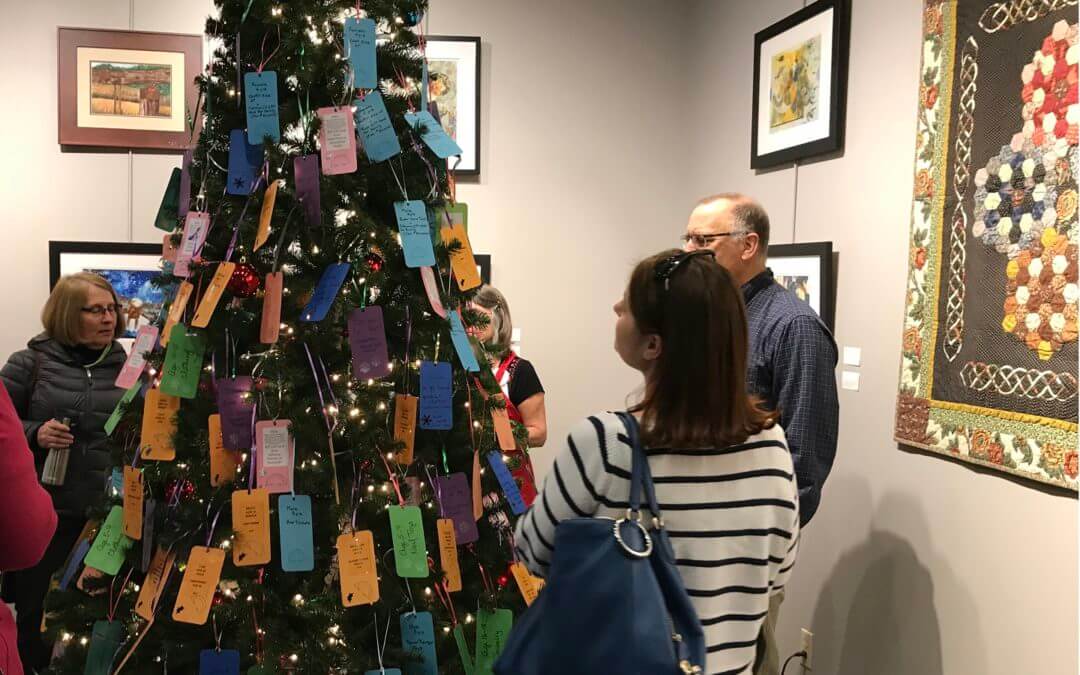
The East Shore Giving Tree concluded on December 10, 2023. Tags, gifts and gift cards were returned to the church and distributed to our six selected agencies: Childhaven, Friends of Youth, Hopelink, Sophia Way, Sound Mental Health, and Youth Care. We started with 190 tags. Your kindness and generosity fulfilled 157 of those wishes. Thirteen tags that were taken may still be returned. We also received $620 in donations plus we maintain a $350 budget line item. The money will be sent to the agencies with unfulfilled requests at $35 a tag plus the remaining money will then be divided up and distributed to the six agencies. You have made a difference in the lives of others.
Here is a message we received from a woman who works at Sound Mental Health, “I work at Sound Mental Health and I wanted to thank you so much for the gifts for our clients that were provided through the Giving Tree. My clients were so grateful to receive these! I saw first-hand the impact of your generosity. We appreciate it!”
Thank you! The Giving Tree Ministry team was comprised of Janis Pock (chair), Sydney Rivera-Gatins, Paula Doe, Kathie Moritis, Milly Mullarky, Marian Hayes, Janet Fleck, and Peggy Phillips. Do you want to join our team? The timing of this Ministry Team is the fall and makes a significant difference in the lives of others. Contact Janis Pock to be added to the team for next year!
Thank you so much for your very generous donations of backpacks valued at $225 to the 28th annual Congregations for Kids’ Good Start Back to School project. Your help made it possible to provide students from low-income families in the Bellevue School District with backpacks and/or home-use school supplies. Some are from families no longer able to make ends meet; some are refugees fromed violence in Central America or war in Ukraine or domestic violence; some are unaccompanied minors or homeless. Specific district student requests for the 2023-24 school year were down to around 2000, a more normal number. We provided 1035 backpacks for students in K, 2nd, 4th, 6th, 9th and 11th. Since the district provided school supplies for classroom use for everyone this year, we no longer needed to provide kits of supplies for those in need. Instead, we provided school supplies to their Family Connections Centers for these students to take home. What is constant since our very first project is that we, with your help, are still helping the students who need it most.
Congregations for Kids is the only organization that works with the Bellevue School District to provide backpacks and home-use school supplies to these children throughout the district. Students in every school except one needed help this year. In six elementary schools, over 40 students were helped; in four middle schools, over 40; and in two high schools, over 40. Numbers of students in various elementary schools needing help ranged from 5 to 198. Since 1996, we have filled over 36,750 requests from the district.
Congregations for Kids, a non-profit interfaith organization, is a program arm of the Eastside Interfaith Social Concerns Council. For your tax-deductible information, our tax ID number is 94-3036001. Our 14-member steering committee consists of volunteers from seven congregations. Our website, www.congregations4kids.org, has updates and photos from this year’s project in mid-August. Please look – you’ll get an idea just how big this project is!
Through your generous gifts, you have helped make it possible for these students to have the backpacks and/or home-use school supplies they needed to have a good start back to school in September. Thank you for showing them that you care about them. On behalf of Congregations for Kids – and all the kids you are helping – thank you so very much!
Sincerely,
Nancy Jacobs
Chair, Congregations for Kids
This year, the Earth and Climate Action Ministry Team (ECAM) plans to partner with our Minister, Rev. Maria Cristina, our Staff, and interested church groups and individuals as we:
LISTEN TO their ideas, concerns, hopes to take care of the earth. We’ll encourage sharing with a few open-ended questions during:
Group meetings we are invited to;
Individual conversations;
A congregant survey.
BASED on ABOVE, SHARE, CONNECT, and OFFER RESOURCES, SERVICES, and PROJECTS.
Collaborate with other groups at the church, local, or global level,
Integrate resources as celebrants at specific themed worship services,
Facilitate an Earth Day Service April 21 and a culminating Earth Celebration event with other interested groups and individuals.
ECAM aims for East Shore’s Mission through:
LOVE of the Earth from which we and all living things evolved and depend– CONSIDER WHAT A LOVING RECIPROCAL RELATIONSHIP BETWEEN US AND THE EARTH LOOKS LIKE;
SPIRIT of known and unknown forces of Nature that create and sustain everything–BE OPEN TO LEARNING TOGETHER;
COMMUNITY of the interdependent web of all the earth’s elements and life–COLLABORATE WITH EACH OTHER AND NATURE in MUTUALLY BENEFICIAL WAYS;
JUSTICE as good stewards who heal and enhance our relationships–DO WHAT WE CAN TO TAKE CARE OF EACH OTHER AND OUR HOME, THE EARTH.
We shared our plan and began our outreach at the newly formed Collaborative Justice Council on November 6. We will invite ALL of YOU to exchange ideas. To schedule a listening session please contact: Kristi Weir [email protected]
Imagine, Learn, and Take Action with Earth & Climate Ministry
“Imagine the air as the earth’s skin. It is amazingly thin compared with the size of the planet. This air layer is far thinner than the skin of an apple compared with its diameter. Underneath it lies ocean and rock, and upon that rock, lies a wee bit of soil and greenery. Yet inside this fluctuating layer of air, between a rock and a cold place, all life is protected and nourished.” –Adapted from Per Epson Stokes